

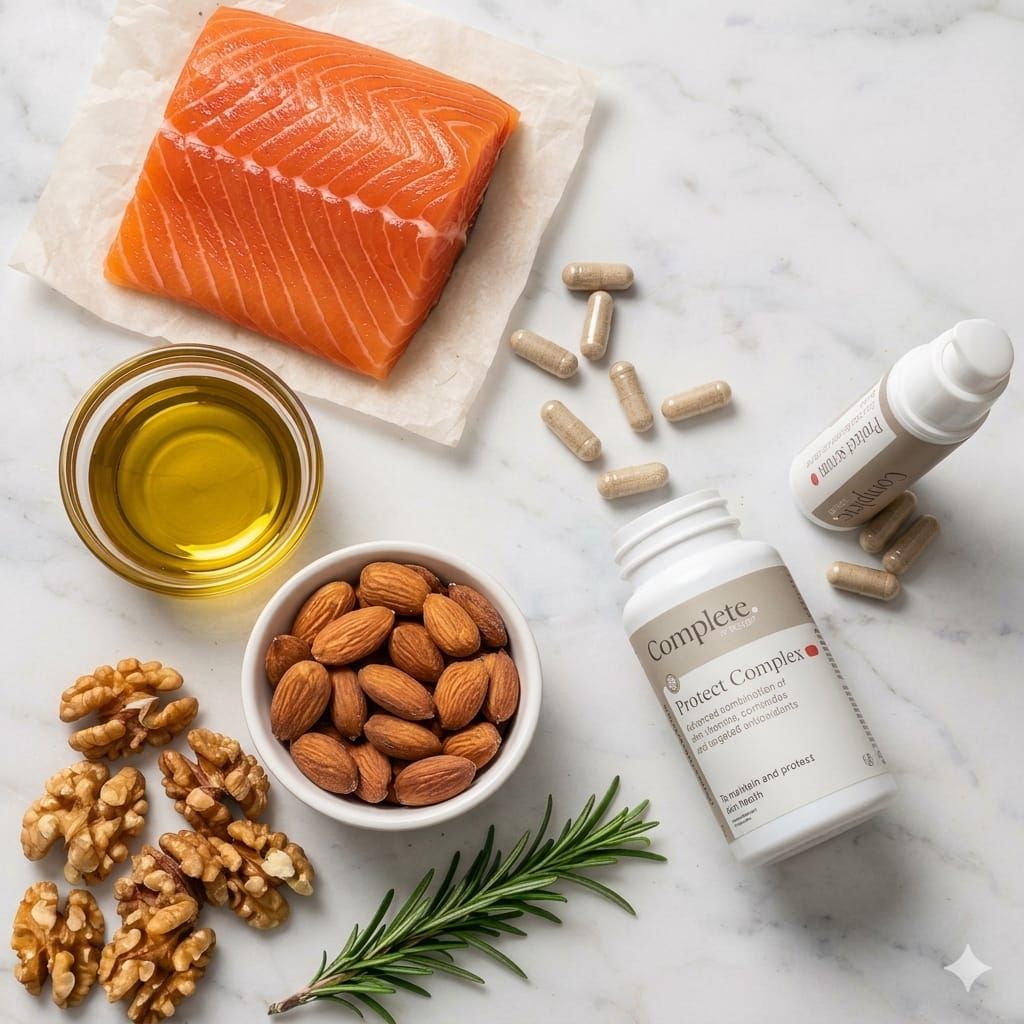
Your Skincare Routine Is Incomplete
Your Skincare Routine Is Incomplete
The beauty industry is obsessed with the routine.
Three steps or seven. Korean-inspired ten-step layering or the stripped-back minimalist approach. Every few years the pendulum swings, and the conversation shifts from “you need more products” to “you need fewer products” and back again.
But the entire debate stays on the surface. Literally. Whether it is three steps or thirteen, the industry is only ever talking about what you apply topically. The question is always how much you put on your skin and in what order, and very rarely what is happening underneath it.
People follow trends and switch routines. They layer acids, peptides and retinoids based on whatever the current consensus says, and still do not achieve the outcomes they expect. That is not a failure of discipline. It is a failure of approach.
The problem is not the products. It is the pathway.
I spent 15 years in the pharmaceutical industry before I started a skincare brand. Designing a treatment that only addresses the surface presentation of a condition while ignoring the systemic factors driving it would never be considered acceptable in medicine. You cannot expect a single-route intervention to solve a multi-pathway problem, and that is something the beauty industry still has not moved past.
Skin is the largest organ in the body, but it sits low in the nutrient delivery hierarchy. When the body distributes vitamins, minerals and amino acids through the bloodstream, the internal organs are prioritised. The skin receives what is left. That places a ceiling on what topical formulations, no matter how well designed, can achieve on their own.
The stratum corneum exists specifically to keep things out. That is its job. So the idea that we can solve every skin concern by adding more products on top of a barrier designed to resist penetration is, at best, incomplete thinking. Whether you are applying three products or ten, you are still only addressing one delivery route.
What we found when we tested the combination approach
We ran three independent 12-week consumer panels, one for each of our systems, with a combined 93 participants. The panels were structured with assessments at baseline, four weeks, eight weeks and twelve weeks.
Across all three panels, the inside-out approach, a targeted topical paired with a matched oral supplement, was rated as making more sense than topical-only skincare by 90% of participants. The majority also reported that the combination was more beneficial than single products they had used previously.
But the data that stood out most was not about product performance. It was about understanding.
“I have never really thought about what is going on inside my body can have such an effect on my skin.”
“I’m amazed how well the system worked from within and outside.”
“Internal health is just as important as expensive skincare.”
That is what a combination approach delivers. Not just a shift in perception, but a fundamentally more comprehensive way of addressing skin health, one that works through multiple pathways rather than relying on a single route of delivery.
A better system, not a longer routine
That is what Complete by Dr SCS was built around. Not how many products you use, but whether your skincare is actually reaching your skin from every direction it needs to.
The answer to better skin was never about adding more steps to the same routine. It was about changing what a routine can do.
Explore the systems at completebydrscs.com
–

Join our mailing list
Stay in the loop! Join our newsletter for exclusive updates and promotions
Articles we think you will like

Can oral supplementation benefit the gut-skin axis?
Why Joint Health Matters: The Collagen Connection Women Need to Understand
32.9% Wrinkle Reduction in 8 Weeks: Inside the Clinical Trials
Beyond Animal Collagen: The Science of Human-Identical Collagen
The Science Behind Clear Skin: How Your Gut Microbiome Controls Breakouts
Most people are wasting money on retinol. Here’s why.

Why Your “Sensitive Skin” Might Actually Be Damaged Skin
Stress & Skin Health: Understanding the Cortisol Connection